Ruddygore Project
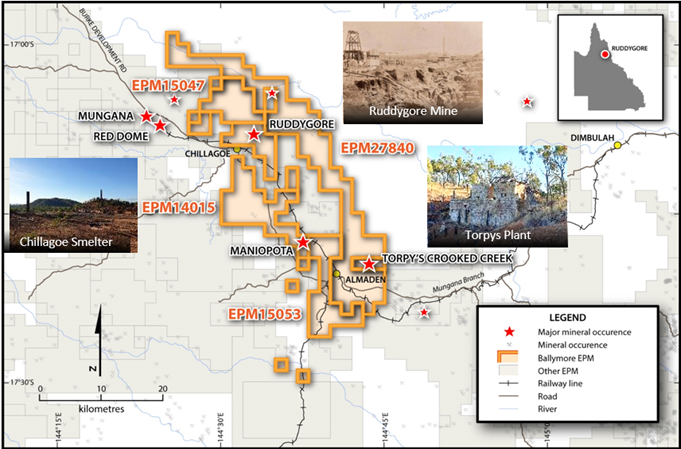
The Ruddygore Project is located adjacent to the town of Chillagoe in North Queensland and approximately 150 km west of Cairns. It comprises four granted EPMs and an EPM application covering an area of 556 km2. Historically, Chillagoe was a significant mining and smelting centre that was most active from 1888 to 1927, prior to further substantial production of gold, copper and silver from the Red Dome mine from 1986 to 1997.
The Ruddygore Project area hosts a range of different deposit styles including porphyry copper-gold deposits (e.g., Ruddygore), skarn-hosted copper-gold-lead-zinc skarn deposits (e.g., Red Dome, Mungana, Maniopota), sediment-hosted massive sulphide lead-zinc-silver deposits (e.g., Torpy’s), tungsten-molybdenum greisen deposits (e.g., Scardons Top Camp and Bottom Camp) and intrusiverelated gold system (IRGS) deposits. The project area is poorly explored, and Ballymore is systematically applying modern exploration methods to test these historic mines and new targets with the aim of delineating bulk tonnage gold and base metal deposits.
Recent Exploration
Drilling continues to confirm scale and grade potential of Torpy’s Discovery
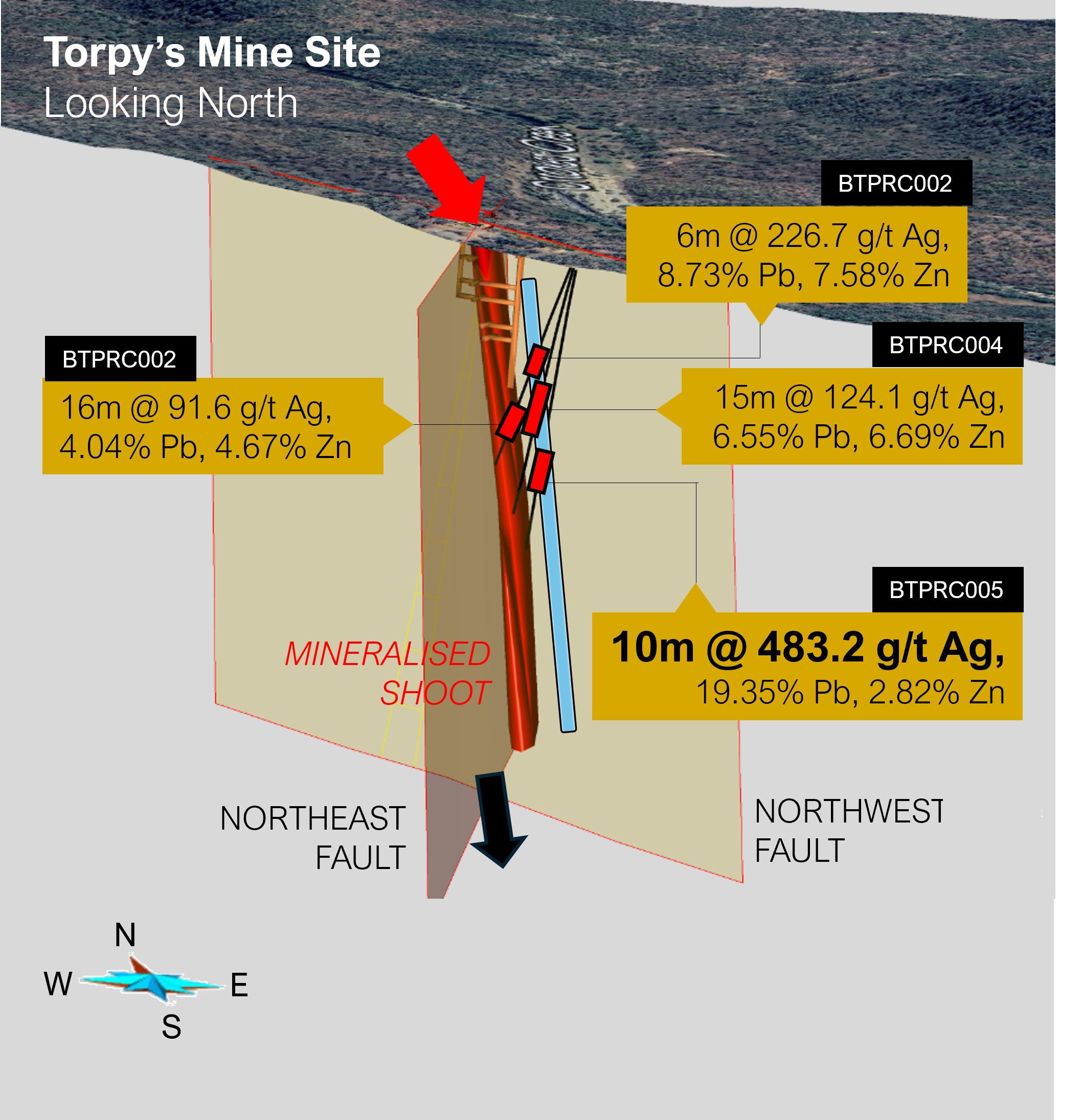
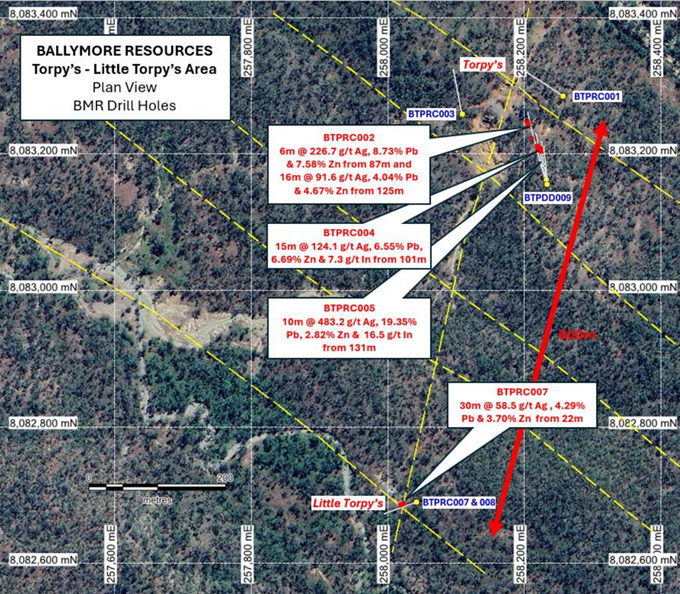
On 14 January 2026, Ballymore reported assays from hole BTPRC005, confirming the richest intersection from the Torpy’s drilling program to date. The hole returned 23m @ 215.6g/t Ag, 8.55% Pb and 1.99% Zn from 130m, including 10m @ 483.2g/t Ag, 19.35% Pb, 2.82% Zn & 16.5g/t In from 131m, including 7m @ 650.7g/t Ag, 25.37% Pb, 3.01% Zn & 14.2g/t In from 132m. Maximum individual 1m values of 987g/t Ag, 38.59% Pb, 11.98% Zn and 82.95g/t In, together with anomalous gold and copper up to 0.247g/t Au and 0.58% Cu were reported.
The zinc-rich halo observed around the main mineralised shoots may assist with recognising additional mineralised positions near the Torpy’s system. The results continue to support the interpretation of a broader intrusive-related mineralised system at depth. A diamond drill hole, BTPDD009, was also completed during the quarter to provide additional structural information beneath the main Torpy’s workings.
Initial Little Torpy’s step-out hole confirms broader system
On 6 February 2026, Ballymore reported assays from the first hole drilled at Little Torpy’s, located approximately 600m south of the main Torpy’s workings. Hole BTPRC007 returned 30m @ 58.4g/t Ag, 4.29% Pb & 3.70% Zn from 22m, including 7m @ 65.6g/t Ag, 5.90% Pb & 4.78% Zn from 23m, and 6m @ 153.0g/t Ag, 10.24% Pb & 8.56% Zn from 41m, including 1m @ 293.0g/t Ag, 19.96% Pb & 9.36% Zn from 45m.
These results represented the first drill confirmation of significant mineralisation at Little Torpy’s and show strong support for the scale potential of the wider Torpy’s system, demonstrating the capacity to host multiple high-grade lenses across the broader project area.
Previous Mining
The Ruddygore Mine was mined from 1896 to 1909 by open cut and shaft access to underground. The mine yielded 1,450 tons of copper from 32,750 tons of handpicked ore at an average grade of 3.9% Cu and 56 g/t Ag.
The Maniopota mine is a skarn deposit mined for lead, zinc, and silver. No production records have been found for this site, but it hosts a series of small pits over 1 km strike length.
The Torpy’s Crooked Creek mine operated from 1904 –1914 when production included 6,000 tons of ore yielding 84,000 oz silver and 920 tons of lead at average grades of 15.3% Pb and 435 g/t Ag.